
CELESTIAL VISITOR
AN INCISIVE UPDATE

A number of readers have weighed in concerning my recent posts about 3I/ATLAS and what it may portend, including the unfortunate realization that Michio Kaku’s video was apparently an AI creation. Since that doesn’t mean the AI version was all misinformation, this set me on a quest to try to determine what might be true or not. But I’m not an astronomical expert by any means, and so haven’t been sure what more to say.
Then this morning, my friend Madhava Setty sent me his latest substack. He calls it “An Insult to Intuition.” You can read his posts here: madhavasetty.substack.com I found his latest an incisive and highly informative piece about this remarkable celestial “visitor.” Madhava kindly gave me permission to also give him a guest post on my substack, Here it is:
“There’s something interesting that has been heading our way. I’m not talking about a Great Reset, financial collapse, another pandemic or false flag event. I’m talking about an object moving towards the inner solar system at breakneck pace. First spotted by the Asteroid Terrestrial-impact Last Alert System (ATLAS) station at Río Hurtado, Chile, on July 1st, 2025, the object called 3I/ATLAS will be reaching its closest point to the Sun (its perihelion) later this month.
Details from Wikipedia (if you believe that source) are vague with regard to its size (0.2 to 3.5 miles in diameter) and period of rotation. The scientific consensus offers nothing spectacular. Of note, however, is that
3I is emitting CO2 much more than water
it is emitting Nickel much more than Iron vapor
detection of Nickel vapor was detected before Cyanide gas
it had been emitting a dust plume towards its direction of motion, not away
These features, I have learned, are not typical of comets but neither are they Earth-shattering, literally or figuratively—3I will not be colliding with our planet, in case you were interested.
The thrust of this essay centers around two extraordinary facts. The first is that unlike the tens of thousands of newly identified objects that approach us and leave every few years, 3I/ATLAS is not from our solar system. The second is that the scientific community seems to be unimpressed by this fact.
To see why their response is so peculiar we have to understand not only how rare such visitors are but why they are so rare. Most of the source material I am using for this article can be quickly extracted through basic Chat GPT queries.
Since the the turn of the century tens of thousands of new objects on Near Earth trajectories are being identified each year. They are elements of our solar system which was created by the accretion of interstellar dust which led to the formation of the Sun, planets and comets a few billion years ago.
Everything in our solar system either orbits the Sun or planets which in turn orbit the Sun.
3I/ATLAS doesn’t.
How often do we host objects from outside the solar system? To our knowledge, never, at least until eight years ago when a cigar shaped object was spotted leaving the inner solar system at a clip exceeding the escape velocity of the Sun. Such a thing had never been seen before.
A new nomenclature had to be introduced. The object was named 1I/’Oumuamua. ‘Oumuamua is the Hawaiian word for “a messenger from afar arriving first” (it was discovered by Robert Weryk using the Pan-STARRS telescope at Haleakalā Observatory in Hawaii).
“I” for interstellar. And “1” because it was the first of its kind.
Just two years later another interstellar object was identified: 2I/Borisov. Today there is 3I/ATLAS. A graze through the internet will lead you to believe that this sort of thing has probably been happening regularly outside our notice. Nothing really to see here folks.
Methods of detection are much better now. More and bigger telescopes are pointed at the heavens, automated image processing allows for detection of tiny objects which are moving against a field of relatively motionless stars. Why be so surprised that we have only recently become aware of interstellar objects in our solar system?
But we have been cataloguing thousands of new objects in our solar system every month for decades and only three have been confirmed to be from outside our solar system. They all have appeared in the last eight years. If this was nothing new we should have been picking these things up for a while. We haven’t. According to this source, we have been spotting roughly the same number of new objects since the turn of the millennium yet only these three have been interstellar.
There isn’t a lot of stuff between the stars. It all gets mopped up by stellar gravitational fields over time. This also makes it impossible for an object from another star system to find its way out, unless it possesses a significant amount of kinetic energy to begin with. This should lead us to ask, is it even possible for an object to leave one solar system and enter another?
Well, we know that it can happen. Our species has sent five spacecraft on trajectories with enough velocity to leave our solar system:
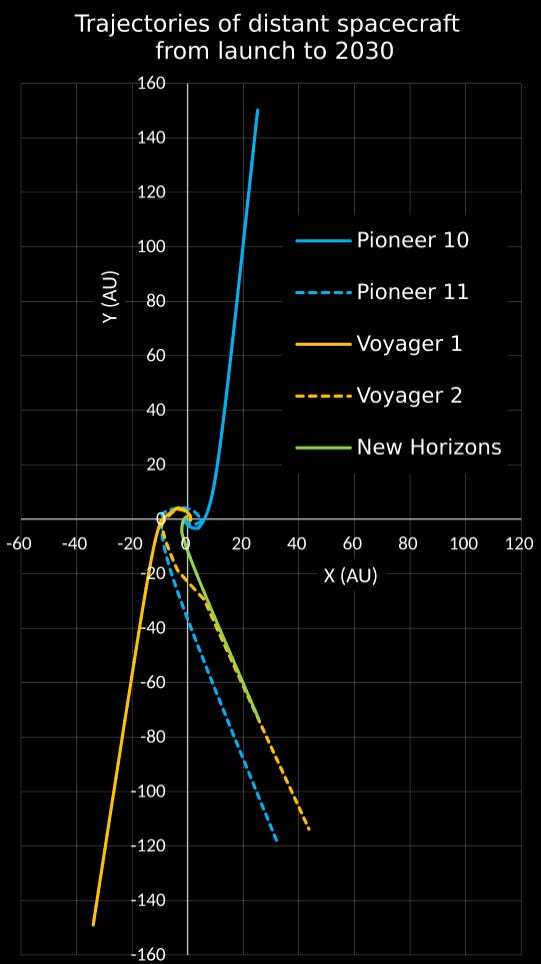
The center of the axes is the Earth from a polar view. Notice how the paths of these craft begin with tight turns near the start of their epic journeys but straighten further out. This is because their trajectories were designed to harness the gravitational fields of planets on their path which served to bring them in and then fling them off towards the next, picking up enough momentum so that they will eventually leave the solar system.
But these were objects launched from Earth with multi-staged rocket engines and “slingshotted” along. What about natural objects?
It is generally thought that objects like 1I, 2I and 3I must have originated from supernovae, a violent end of life event which stars of a certain mass experience. Supernovae explosively eject material and energy throughout the galaxy.
The other possibility is that during the formation of a star cluster the object may have been flung from the area due to a coincidental interplay between gravitational fields between the fledgling suns. The point being is that there are known, natural phenomena that can impart an object like 3I with enough kinetic energy to escape a star’s gravitational field.
3I approached us from the general direction of the constellation of Sagittarius, which is known to be an area of several supernovae. It gets complicated when examining things that are very far away from us. These supernovae are tens of thousands of light-years away, which means we are observing them as they appeared tens of thousands of years ago. If 3I originated there, even if it was put on a direct course to us, it would not arrive for tens of millions of years. If 3I was the product of a supernova it must have occurred elsewhere and much further in the past.
Perhaps it has been slaloming interstellar space for billions of years, whipping around star systems that launch it in one direction and the next so that it eventually found itself here. The nearest star system in the direction from which it is thought to have originated is called Ross 154, about 9.7 light-years away. If 3I had once been speeding its way to Ross 154, perhaps the star redirected it towards home sweet home.
Given its present speed (about 0.02% the speed of light) it would have taken 3I about 50 thousand years to get here, a blink of an eye in a cosmic time frame. But the more intriguing part of this hypothesis is the astounding accuracy Ross 154 must have demonstrated in redirecting 3I towards us. 3I came within 1.4 AU (Astronomical Units) of the Sun. An AU is the distance between the Earth and the Sun, about 93 million miles.
Proportionally it would be the equivalent of a bullet 0.3 inches in diameter (say from a Mauser 30-06) hitting the bulls-eye dead on from about three miles away. I suppose if Ross 154 was a highly trained sniper with a properly calibrated scope adjusting for “solar winds” it is a possibility, especially if the experts tell us there are no other theories under consideration.
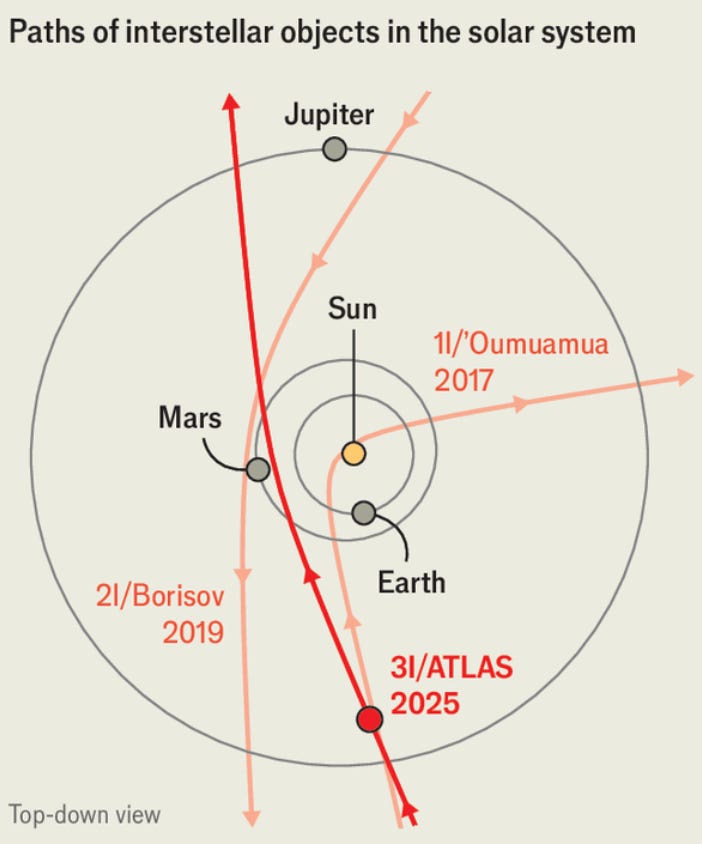
From the diagram above you can see that compared to 1I, 3I and 2I were relatively errant bullets which sought the Sun as a target. 1I/’Oumuamua got seven times closer to the target than 3I, an even more astounding example of cosmic marksmanship.
Of course the Sun is not an inert target, it draws anything with mass towards it. However 3I is officially moving along at around 58km/sec, almost twice the velocity required to leave the solar system. And its path is highly eccentric (e > 6), indicating that it is passing through at nearly a straight line. This means that it already had a pretty good bead on us before our Sun began to draw it in.
Yes, 3I could have been put on its path towards us eons ago through natural phenomena. But what about 1I and 2I? Is it unreasonable to ask if someone is shooting at us?
Not only has 3I been moving towards the Sun with stunning accuracy, unlike its predecessors, its path is nearly level with the ecliptic, the plane on which the planets orbit the Sun. If the solar system was a flat target, 3I managed to strike it edge on. This means that it will travel in proximity to several planets as well much like the probes we have launched. Is it likewise unreasonable to ask if someone out there isn’t trying to shoot us but is curious about what’s going on in our solar system these days?
Avi Loeb, Professor of Science and previous Director of of the Institute for Theory and Computation at the Center for Astrophysics at Harvard University, thinks its a perfectly reasonable question.
As early as July of this year Loeb was already worried that 3I is an Alien Probe and the scientific community should take notice. Establishment scientists disagree. Tom Statler, NASA’s lead scientist for solar system small bodies, told The Guardian:
“It looks like a comet. It does comet things. It very, very strongly resembles, in just about every way, the comets that we know.”
“It has some interesting properties that are a little bit different from our solar system comets, but it behaves like a comet. And so the evidence is overwhelmingly pointing to this object being a natural body. It’s a comet.”
But here’s NASA’s own definition of a comet:
“Comets are cosmic snowballs of frozen gases, rock, and dust that orbit the Sun”
But Statler and the entirety of the establishment acknowledge that 3I doesn’t orbit the Sun. Wikipedia also repeatedly refers to 3I/ATLAS as an “interstellar comet”, an oxymoronic term. Is the misdirection deliberate?
Statler’s argument is that because it “behaves” like a comet the evidence is “overwhelmingly pointing to this object being a natural body.” That’s neither an argument nor overwhelming evidence. While he and all other establishment astronomers conspicuously decline to address any of the undisputed peculiarities I have mentioned here, some nevertheless openly deride Loeb’s suggestions.
Professor of Astrophysics at Arizona State University Steve Desch, PhD is reported as saying that Loeb is
“conflating the good science we do with this ridiculous sensationalism and sucking all the oxygen out of the room.”
Conclusion
Objectively speaking,
nobody knows what 3I/ATLAS is or where it came from
given the undisputed and remarkable peculiarity of 3I’s trajectory and speed relative to our solar system, there ought to be more thoughtful statements coming from the experts
there seems to be an effort to downplay the arrival of this object
it is only logical to conclude that it is a natural body if we refuse to consider the existence of a non-human intelligence behind it
It is this last point which is of the most interest to me. Let us say that Extraterrestrial intelligence in the universe was a given. Which theory would garner the most support?
Most scientists would agree that there must be intelligent life out there. The MilkyWay galaxy, let alone the known Universe is far too big and too old to have life emerge on our planet exclusively of everywhere else. This is where things get murky. Because the public is only aware of technology which would make an interstellar journey possible but too long to be practical, we can sleep at night accepting that ETs are probably out there but they most definitely cannot be here. It’s a comforting but illogical story.
Why are we so dismissive of the idea that these interstellar “comets” might be exploratory probes launched eons ago given that we ourselves sent our own on their way in the recent past? Is it because these objects don’t have radio antennae or Plutonium‑238 powered thermo-electric generators like the Voyager craft?
Let us for a moment envision the best version of ourselves ten thousand years from now. Free energy devices are powering the world. Every individual has their basic needs met. War has become obsolete and our species cooperates at a global scale. We have developed technologies which we cannot imagine right now. What would the spacecraft we build look like and how would they function?
Perhaps we would reflect on this current time as a crucial turning point in our history. Perhaps we would have become aware that every planetary civilization reaches the very same moment in their evolution where they choose a path of either peace and cooperation or endless conflict and eventual self-destruction. Wouldn’t we be interested in how neighboring planetary civilizations who were at this juncture were doing? How would we know if they were ready to be introduced to the neighborhood?
I suggest that if we had the wisdom to pick peace and cooperation for ourselves we would also see the harm in interfering with another civilization’s path. Sustained peace cannot be enforced from the outside. It must be chosen from within.
If ten thousand years from now we were to send a craft to probe another solar system known to have life with the technology we have today is it so farfetched to think that we would pick a design which would belie its purpose so that we could observe a civilization without interfering with it too much?
Perhaps 3I/ATLAS isn’t here to scan us as much as it is to nudge us to a period of reflection necessary before big choices should be made. At the very least 3I’s presence is reminding us that those in charge have conceptual blind spots, are being disingenuous, or both.
Please share your thoughts in the comments.”
Beautifully thoughtful article, which invites us to humility and authentic reflection about our future, our universe and our relations with all life.
3I/ATLAS could be seen as a semen, impregnating one solar system after the other.
Its timing is unprecedented, passing by Mars, at Full Moon, then Venus, again at Full Moon.
During New Moon last Monday there was a coronal mass ejection from the Sun towards 3I/ATLAS, just when these aligned with Earth and Moon. It will be at its closest to the Sun at October 29th, the day Edgar Cayce predicted a ‘Blade of Flame’! Finally, at around Winter Solstice, 3I/ATLAS will be at its closest to Earth.
For more details, please check out Heather Ensworth on Youtube.