
THE LATEST ON AI
FROM MY WRITER FRIEND TEDDY MACKER

Teddy has given me permission to publish his latest piece about AI and its impact on our civilization that he’s written for the Front Porch Republic. It’s long but I highly recommend you read it.
In Defense of Our Country: On the Need to Resist AI and AI Data Centers
The holiness of the world: that is the heart of the matter. The doors of perception must be cleansed to see the holiness again.
June 16, 2026
We the People of the United States, in Order to form a more perfect Union, establish Justice, insure domestic Tranquility, provide for the common defense, promote the general Welfare…
– The Constitution
I know of no safe depository of the ultimate powers of the society but the people themselves.
– Thomas Jefferson
We have no government armed with power capable of contending with human passions unbridled by morality and religion. Avarice [or] ambition … would break the strongest cords of our Constitution as a whale goes through a net.
– John Adams
We have to abandon the arrogant belief that the world is merely a puzzle to be solved, a machine with instructions for use waiting to be discovered, a body of information to be fed into a computer in the hope that sooner or later it will spit out a universal solution.
– Vaclav Havel
We live in a world where justice equals vengeance. Where private profit drives public policy. Where the body of civil liberties, won cell by cell, bone by bone, by the brave and the dead, withers in the searing heat of “all war, all the time.”
– Toni Morrison
We must avoid the impulse to live only for today, plundering, for our own ease and convenience, the precious resources of tomorrow. We cannot mortgage the material assets of our grandchildren without risking the loss also of their political and spiritual heritage.
– Dwight Eisenhower
Neither love nor terror makes one blind: indifference makes one blind.
– James Baldwin
A democracy cannot survive merely by being well-informed, it must also be contemplative and wise.
– E.B. White
Could there be knowledge, the possession of which, at a given time and stage of social development, would be inimical to human welfare—and even fatal to the further accumulation of knowledge?
– Robert Sinsheimer
We are in the grip of institutionalized madness.
– Robert Ellsberg
The physical world, regarded as so much dead stuff, becomes the scene of man’s uncurbed exploitation for purely practical, utilitarian, or acquisitive ends…. This is why the application of science—which is not really the application of science at all but the application of an unbelievable ignorance—has produced such disequilibrium, ugliness and even destruction not only in the natural world but in human life as well.
– Philip Sherrard
Thich Nhat Hanh loved telling the story of a man riding a horse. The horse gallops along as if the man is on a mission of great consequence. Another man sees the rider tearing down the road and shouts, “Where are you going?” The rider yells back: “I don’t know! Ask the horse!”
This teaching came to mind while thinking about artificial intelligence. One might say that our country is riding a horse, and we have no idea where it is taking us. But after reflection, I see that this is not quite right. We do have an idea where this new technology is taking us.
Because Gandhi didn’t have an expert’s sense of economics, it allowed him—some claim—to see economic arrangements with fresh eyes. Because he didn’t get lost in the endless niceties of complexity, he was able to see the big picture, as we say now, and this big–picture vision enabled him to suggest and sponsor healing, hidden-in-plain-sight reforms. We should perhaps remember this claim about Gandhi when it comes to AI. We don’t have to be podcast-hosting experts with “150 IQs” fluent in tech-speak to shape the general welfare of our country. We don’t have to use phrases like “inflection point” and “preference cascade” and “effective accelerationism” to stand up and be counted. In fact, in order for our country to be our country we need to stand up and be counted, for we are, as Thomas Jefferson says, “the safe depository” of this country’s “ultimate powers,” no matter what the cynics and the understandably demoralized might believe.
Before I myself attempt to present the big picture, I hasten to stress that I know that those who use AI—which is all of us, to a certain extent—are not somehow bad because of that use. (No one, by my lights, is “bad.”) Many use it out of curiosity. Many assume that by using it they are sensibly accommodating change. Many are expected to use it at work or school. Many are so pained and cut-off that AI perhaps feels necessary for getting by. So while what follows is definitely an indictment, it is one that hopefully avoids any hectoring self-righteousness.
Okay, now for the big picture.
A new technology with various uses, various operational needs, and various effects is entering our lives. It is called, eerily I believe, “artificial intelligence.”
And what do we hear about this technology? We hear many things.
We hear about “deepfakes,” AI-generated images and videos, which can cause anguish in the lives of fellow Americans and which can mislead large groups of people. Of these images and videos, Hany Farid, dubbed “the world’s leading deepfake expert” by The New York Times, says: “The technology is getting so good. It takes me to a dark place … Within a year or two, our whole visual system will be utterly useless.”
We hear how this technology is involved in an intellectual blackout, or what some call “cognitive surrender,” among young people. Instead of reading deeply, thinking carefully, and then composing essays; instead of studying and taking tests; instead of doing homework assignments and chewing on timeless questions with friends, many students now use ChatGPT.
We hear how this technology is putting artists out of work. Some people (often without knowing it) now read AI-made “books,” listen to AI-made “music,” purchase AI-made “paintings,” and watch AI-made “movies.”
We hear how this technology is suddenly and radically transforming relationships: many teens, for example, now have AI “friends,” AI “lovers,” and AI “therapists.” Relatedly, we hear how many people already rely—emotionally and mentally—on AI for daily decision-making.
We hear how this technology is making for greater surveillance of our populace— how it is “harvesting information” from us, engaging in “human fracking,” in the interest of government spying and corporate profits.
We hear about the threat of “hacking bots” capable of taking down electrical grids and breaking into banks.
We hear how AI is changing war, impressively turning something hellish into something hellish-er, replete with AI-generated “kill lists” and “autonomous” drones that—presumably heeding these kill lists—track humans down, wherever they are, and pitilessly kill them. (Lethal robot dogs are in the works.) Anthropic CEO Dario Amodei has said that artificial intelligence could be “the single most serious national security threat we’ve faced in a century, possibly ever.”
We hear—and from many of AI’s creators—that the integration of AI into our society will cause widespread job loss, what’s been termed a “job apocalypse.” (AI has been called both a “human job elimination machine” and a “human elimination machine.”) The International Monetary Fund claims AI will affect 40 percent of jobs worldwide. Jim Farley, the CEO of Ford, asserts that it will eliminate “literally half of all white-collar workers” in a decade. Anthropic CEO Dario Amodei essentially echoes Farley, saying AI “could wipe out roughly 50% of all entry-level white-collar jobs.” And Matteo Wong of The Atlantic recently writes: “The medium-term success of generative AI would likely involve millions of people being put out of work.”
We hear, via a Quinnipiac University poll, that a majority in America fear AI will do more harm than good. A new Gallup poll shows 70% of Americans oppose the construction of data centers in their communities. According to a poll from Stanford University, the United States reported the lowest trust in its own government to regulate AI responsibly of any country surveyed. We also hear that America—despite its role as the world’s AI pioneer—generally resists AI more than most other countries. “In polls,” writes Lila Shroff of The Atlantic, “the United States ranks among the countries most concerned about AI. America is both the world’s foremost developer of AI and its chief hater.” (AI skepticism, we also hear, spans our politics, ranging from Bernie Sanders and Alexandria Ocasio-Cortez to Tucker Carlson and Ron DeSantis.)
We hear how this technology is furthering our estrangement from actuality, from Creation, worsening what David W. Orr calls “our growing disjunction with Earth.”
We hear that this technology will concentrate wealth and power even more morbidly than both are already concentrated.
We hear how some AI creators are openly suspicious of democracy and sympathetic to eugenics. We hear that some are building elaborate “doomsday bunkers” and planning “sovereign colonies” free of government regulations in our oceans, in foreign countries, and in space. And we hear that the president of Argentina wants to completely deregulate AI in his country and help create something called the “non-human corporation,” a legal entity owned and operated completely by AI robots. Says Forbes of such a corporation: “Imagine a company with no CEO, board or human employees—just artificial intelligence making every decision, signing contracts and owning assets in its own name. That scenario once felt safely hypothetical—ripe subject matter for SciFi movies and novels for years.”
We hear of the technology’s theological implications, of the possibly sacrilegious hubris of its creators, boosters, and users, as if by creating, boosting, and using this technology humans are trying to assassinate God and take the empty throne. Relatedly, we hear how some AI creators are sincere “transhumanists,” believing that we humans should literally meld with the machines. (Transhumanist ambitions vary. Recently I read of the transhumanist ambition to escape our mortal coil by somehow rendering our consciousness into digital form, then somehow merging that digitalized consciousness with AI, thereby—somehow—attaining “immortality.”) We also hear how some AI creators are sincere “posthumanists” or “AI successionists,” believing that our planet is auspiciously approaching the end of Homo sapiens, that artificial intelligence will soon replace lowly human beings altogether. Elon Musk on X notably said “… it increasingly appears that humanity is a biological bootloader for digital superintelligence.” Another tech leader, Guillaume Verdon, has said that his vision of artificial intelligence has “no particular allegiance to the biological substrate.” While another tech leader, Nick Land, has reportedly asserted, “Nothing human makes it out of the near-future.”
We also hear from some AI creators that this technology might spur a new sort of dictatorship: the bot-led dictatorship of a technology in delirium. “With artificial intelligence, we are summoning the demon,” Elon Musk has said. Musk has also said: “I think we should be very careful about artificial intelligence. If I had to guess at what our biggest existential threat is, it’s probably that. So we need to be very careful.” Anthropic CEO Dario Amodei has observed that “people outside the field are often surprised and alarmed to learn that we do not understand how our own AI creations work. They are right to be concerned: this lack of understanding is essentially unprecedented in the history of technology.” Paul Kingsnorth has mentioned that Sir Geoffrey Hinton, the British so-called “godfather of AI,” thinks there’s a concerning chance (“10% to 20%”) that artificial intelligence will lead to “human extinction” within three decades. And Stuart J. Russell, a professor of computer science at UC Berkeley, colorfully adds this: “We need to recognize the possibility that not only may the bus of humanity be headed towards a cliff but the steering wheel is missing and the driver is blindfolded.”
In the face of the foregoing facts and claims and beliefs (facts and claims and beliefs that should prompt in us a necessary stunned silence), we also hear that this technology is inevitable, that it’s the future, that it’s in fact already here, so there’s no use fighting against it, no use arguing with reality.
“We are told that nothing human will survive this transition,” writes David S. D’Amato of Counterpunch, “but that we should nonetheless hurry the unfolding process along.” “We keep hearing in the news that the CEO of some big AI company is worried he is making god,” writes Michael Toscano, director of the Family First Technology Initiative at the Institute for Family Studies, “or threatening all life on earth—but the work must keep going.”
To not hurry the process along, to not keep going, it seems, is what shrill, reactionary, nostalgic, future-afraid, intellectually ninnyish, socially lubberly Luddites do. If someone offers you a seat on the rocket ship, don’t ask what seat. Just get on. Plus, the AI boosters add, the people doubting this technology—the “doomers”—are in fact funded by China or anti-AI Big Tech billionaires jealously guarding their waning markets. (Peter Thiel, “the philosopher king of Silicon Valley” who recently moved to Argentina, has a different take on AI skeptics. Thiel reportedly believes they are acting on behalf of the “Antichrist.”)
And don’t forget (the boosters remind us) we have to beat China in the technological arms race! We mustn’t let them win. We can’t abdicate America’s tech supremacy. We must achieve global dominance. In fact, in order to keep America safe we need to orchestrate mutually assured AI destruction. AI is the new Manhattan Project. If we don’t build it, they will. Institutionalizing madness (trust us!) is strategically sane.
Plus (the boosters elaborate), AI is vital for the future economy. We simply have invested too much money in AI to turn back now. And don’t forget: this is the next industrial revolution! We must avoid safetyism, neutering consumer protections, hyper-regulated stagnation, and woke AI! Let it rip! Let the private sector cook!
Are you seeing what happens if we try to get a handle on the big picture?
Are you seeing how dizzyingly nutty our predicament is?
Are you noticing how far we have traveled from our faculties of reason, from common sense?
Are you noting how so much of this talk sounds like the telltale jabberwocky of a nation gripped by collective insanity?
And if it couldn’t get any nuttier, we now hear via Wired magazine that various federal agencies are “circulating reports with a new domestic target in mind: anti-technology extremists.” Though the technology’s very own creators catastrophize about the technology, publicly processing their crises of conscience, other Americans—equality before the law be damned—might be surveilled and criminalized for calmly and carefully expressing any sort of skepticism. Spencer Reynolds at the NAACP Legal Defense Fund told Wired: “a category like ‘anti-tech extremism’ could be drawn so broad as to ensnare peaceful data center protesters, AI skeptics, and anyone with a bone to pick with technology that permeates modern life.”
But wait a minute, Cranky Cassandra. This so-called “big picture” is nothing more than bloviating sweaty-palmed hysteria. I know a bargain-basement moral panic when I see one. There are actually many good arguments for AI. AI will cure all forms of cancer, neurodegenerative disease, and diabetes within ten years. (And whatever cancers AI and its data centers will cause will presumably be cured as soon as they manifest.) There will be a wave of scientific breakthroughs and a nonzero chance that this technology will solve problems we haven’t even considered. (Then are they really problems?) There will be a Wright Brothers Moment Every Day. There will also be a massive deflationary event the likes of which we have never seen before. Soon the prices of everything will go down! AI will also allow us to live lives free of the drudgery of physical work. (Who wants to do physical work but coarsebrowed knuckledragging cretin-peasants anyways?) And AI will improve quality of life (whatever that means) and make for positive efficiency gains, saving us time (we’ve never heard that one before). And if you think about it, AI will actually allow us to be online less! (But aren’t the bots designed to keep us “engaged”?) And by liberating us from knuckledragging labor and cretinous drudgery (sweeping, dishwashing, knitting, vacuuming, laundering, watering the plants, emailing, thinking, et cetera), we’ll be able to finally recreate all day long—endless leisure at the beach with tie-die hacky sacks and smart glasses! And don’t forget the driverless cars to whisper us back home to our placid newborns in their smart bassinets who have been ably (and free of charge) tended by the AI sitters! And don’t forget the witty-but-obliging hyper-realistic robot-companions! (Is it really cheating if she’s artificial?) And did I mention climate change? AI will soon revolutionize climate solutions without our having to change our lives one tittle!
I hope my point, caustically made, in the paragraph above is coming across. The disturbing claims about AI are on both sides of the ledger. The negatives are negative and many of the positives are negative, too.
In short, this new technology is understood by many Americans of all political stripes to be, at least in large part, the stuff of nightmare, baroque and heinous nightmare. And some of the most alarmed among us appear to be the technology’s creators. (Offering an indictment of AI can feel redundant as its creators do it so capably.) Many of you reading these words could likely rattle off other nightmarish details and anecdotes. I know I could. Such rattlings now make for countless books, articles, lectures, tweets, podcasts, late-night monologues, and vertigo-inducing conversations among parents and grandparents.
As Thich Nhat Hanh said during a talk he gave in November of 2013, humanity’s relationship with technology is not trending in the right direction. “So far,” Nhat Hanh told his audience, “technology has mostly helped us to run away from ourselves at the cost of our own life and happiness, and the happiness of our beloved ones and the beauty of Mother Earth.” Put differently, we appear to be diligently courting cataclysm.
And let us disabuse ourselves of a widespread misunderstanding: the technology is not to blame. We can’t blame AI, no matter how deliriously “autonomous” it becomes. We can blame its creators and boosters and investors and government-enablers and sellers and users (and the users are all of us now, to a greater or lesser extent). The responsibility for the crime never lies with the knife.
And I am sorry to say this, but it gets worse. Much worse. And better. Both.
Regarding how-it-gets-worse, we must revisit the already-mentioned data center “campuses,” whose numbers are growing—growing in a spasm of frightening, under-the-radar, government-pushed profusion. (By the way, America has 5,427 data centers. Big Bad China has 449.)
The operational demands of AI data centers beggar belief. To realize the plans of AI bigwigs in and outside our government, we will have to plunder our country and “Mother Earth” beyond all imagining and likely maintain “all war, all the time.”
As you may have heard, one planned Utah data center “campus” (a ruthless euphemism if there ever was one: campus comes from Latin in which it means field) will have—if not stopped—a 20,000 acre footprint (equivalent to 1000 Walmarts) and demand, at full buildout, up to 9 gigawatts of electricity—more than twice what the entire state of Utah currently uses. Leia Larsen of Grist magazine spoke to Robert Davies, a physics professor at Utah State University, about this proposed “hyperscale” project. Davies said it “could…create a massive heat island capable of devastating the area’s ecology.” Davies also estimated “that the finished project…could produce enough heat to spike nighttime temperatures by as much as 28 degrees Fahrenheit in the high-desert valley.” (Please consider rereading that paragraph.)
Meanwhile, OpenAI, if it has its druthers, will use by 2033 as much energy as used by India’s 1.5 billion people. Of these multiplying AI data centers, Jesse Jenkins, a professor at Princeton, has said: “These are the largest single points of consumption of electricity in history.” (Please consider rereading that paragraph.)
You don’t have to be a clairvoyant to understand that the implications of such data centers for our Earth (meaning you and me and all the other creatures of this speckled, blue, numinous planet) are terrifying. The CEO of OpenAI has said—as if there are no daughters and grandsons, no horses, no songs, no night-blooming jasmine, no grapefruit blossoms, no summer dusks, no dewfalls, no flying fish, no snow, no mothers crying tears of joy gazing on their babies asleep at their breasts, and no salmon splitting the cold clear waters of rivers like red canoes—“I do guess that a lot of the world gets covered in data centers.” If life weren’t so beautiful one wouldn’t mind such words.
Building AI data centers signifies an Earth-savaging (which, of course, is a humanity-savaging) that could make our current disequilibrium and rapacity, our current “adoration of power in its most brutal form” (to borrow words from Simone Weil), our current “destructive, colonial warfare against nature” (to borrow words from Erwin Chargaff), seem almost congenial.
In an AI America today’s cannibal economy could be made to look like a finicky vegan. The uncurbed exploitation of Earth for purely practical, utilitarian, or acquisitive ends and the attendant “thinning of life” already underway will be sped up even more grotesquely.
A quick sketch of the savaging looks something like this: the generation of various kinds of air pollution; the exacerbation of climate derangement; the generation of vast amounts of electronic and nuclear waste; the acceleration of covert mining practices (practices involving child labor); the looting of already dwindling freshwater aquifers (according to the UN, the world has entered an era of “global water bankruptcy”); the mutilation of beautiful “undeveloped” lands and the plants and animals on those lands; the crushing of home values and communities; and what is reported to be insanity-inducing noise pollution.
And the 800 American military bases all over the world; the various military “black sites”; the nearly trillion dollar military budget; the regime change wars; the deaths of human beings, nonhuman beings, and cultures in these regime change wars; the secret piracy of other countries’ resources; the naked piracy of other countries’ resources; the instigation of mass-migrations: we can all but count on not only the maintenance of such imperialistic inhumanities but the increase of them in an AI America.
Such implications should make all supposedly good reasons for this technology shrivel into nullities. There is an unacceptably high risk (ironclad guarantee?) of enormous, widespread misery in the name of hazy, speculative, dubious benefits. That we might destroy ourselves for unprovable medical breakthroughs and to be able to ask ChatGPT about Bette Midler’s filmography is, to put it mildly, a raw deal. The operational demands of the technology alone are inimical to creaturely welfare. Accepting this technology is arguably akin to taking headache medicine even when you know you’re fatally allergic to that medicine. Though it might cure you of a headache, it will finally kill you.
And please remember: that is what some AI creators reportedly want. Some of the most powerful people in our country and world are putting basic assumptions—not only about work, relationships, human flourishing, and human nature but the very worthiness of our shared creaturely life—on their heads. Some AI creators—and it is strange that I find myself writing such words—are open to what’s been called a “post-biological future” in which we have been usurped by our own “artificial progeny.” You can read (and I encourage you to do so) about “AI successionism” in a range of publications from Jacobin to Vox to The Guardian to The Wall Street Journal. Silicon Valley insider Jaron Lanier told the WSJ that some AI researchers complain that humans are too committed to humans. “There’s a feeling that people can’t be trusted on this topic because they are infested with a reprehensible mind virus,” Lanier told the WSJ, “which causes them to favor people over AI when clearly what we should do is get out of the way.”
We ignore or laughingly wave away such an errant vision at our peril. In light of the massive political, economic, and social influence of AI’s creators, we should take time to process the appalling implications of some of their views. (One curious implication is that some of the unacknowledged legislators of our time appear to desire a future barren of human legislation.) In light of our children, grandchildren, nieces, nephews, godchildren, and students (and everybody and everything else for that matter!), we should pay very close attention to the beliefs of some of the people currently attempting to radically and permanently shape the fate of our country and world. It’s been said that when the Europeans first arrived in America in their ships some of the natives on shore could not see them. The reality was so large some natives could not process it—even though it was right there in front of them in the form of strange men walking up from the sea.
And someone please tell me: what will the effects be of a technology that, if it doesn’t immediately bring about some humanity-snuffing dystopia, will most certainly cut us off from each other and our Earth even more? How will such a technology affect the children? We know about the anxiety caused by their iPhone use, by being overprotected in the physical world but underprotected in the online one, and by their worsening disembodiment. We know that too many children already have been pushed to the end of their bent. What will their poor souls be like when their besties are bots, when they’re passing their time lost in the garish hallucinations of their AI headsets, and when they’re starved of meaningful work? Someone tell me! “The theological definition of hell,” says Huston Smith, “is total aloneness, not being connected to anything.” With bots designed to maintain “engagement,” such a hell, arguably, is what an AI America promises many of its children. Scholar Daniel Polikoff calls data centers “the new temples of Moloch, of a monstrous Ahrimanic god.” Moloch, as you may remember, is that fearsome power from the Hebrew Bible, described by Milton in Paradise Lost as a “horrid king besmeared with blood / Of human sacrifice, and parents’ tears.”
And please don’t be snowed by the sundry, fast-talking, money-motivated, Moloch-defending, true believers who tell you “AI will actually reduce suffering and increase joy” (as some of them are telling us). What does such a claim even mean? Such a claim, which is not as uncommon as you might hope, is the height of superstitious scientistic irresponsibility. And don’t be snowed by glib confident talk of nuclear energy (whose waste still is radioactive and still must be stored without error until kingdom come). And don’t be snowed by glib confident talk of how “AI supports biodiversity” through the “monitoring” of Earth’s various creatures. Remember: the Earth-polluting, habitat-devouring demands of AI and biodiversity are not exactly amicable. Such “monitoring” is actually tantamount to putting numberless notches on the gun barrel.
The only reasonable talk now is talk of resistance.
Despite the social lie proclaiming the inevitability of an AI America, the only reasonable talk now is not just about “slowing it down” and “regulating it” and “aligning it with human values”—but resistance.
Humane peaceful fierce resistance.
And thankfully that is happening. That is the good news I wanted to tell you about. Backbones are straightening again. Despite a wider context of indifference, distraction, procrastination, corrosive partisan vitriol, and cynicism, many inspiring Americans (who are feeling the techno-optimist’s machinations like rocks shattering the teeth) are disobeying the orders of their time and choosing to not use AI as much as possible and to raise hell (peaceably) to prevent AI data centers from proliferating and destroying their communities. Many Americans are reminding us that free will, agency, self-determination, or whatever you care to call it, is like oxygen for our humanity and our democracy, and that “inevitability” doesn’t have to last that long. Many Americans are relearning No and the power of rejection. Many Americans are refusing to let this ill present moment press them into its mold. Americans have been in the habit of saying yes to everything for far too long now—whether through explicit acceptance or the dissipating effect of what Walter Brueggemann calls “achieved satiation” (the getting and spending that waste our powers) or a sense of helplessness.
Now, many Americans are saying this far and no farther. Many are saying there is some shit I will not eat. Many are remembering that we are the safe depository of the ultimate powers of this country, that fundamental decisions concerning the general welfare and the welfare of our children should not be made without us.
Red and Blue, rich and poor, country and city, environmentalist and farmer, black and white and native, many Americans are waking up and defending their home places, defending America, defending the Earth. Perhaps this crisis—the crisis of AI, a new technology that many of us rightfully fear—is what it takes for us to finally come together to heal our interrelated, deeply wounded whole.
Vaclav Havel said: “The main task in the coming era is a radical renewal of a sense of responsibility. It is my belief that there is only one way to achieve this—we must discover a new respect for what transcends us … for the earth, for nature, for life, and for reality.”
Havel’s words seem to bring us to the root of our predicament.
It is my belief that we will not be able to successfully defend our places, defend our communities, defend our country, defend our Earth, without a renewal of the perception of the holy. The holiness of the world: that is the heart of the matter. The doors of perception must be cleansed to see the holiness again.
The peaceful revolution of values and lifeways that is needed now must have for its foundation the old awe—the awareness of the unspeakable and unquantifiable worth of being and this planet which is inseparable from being. At a certain point, we all must apprehend again—apprehend this mystery which is here because of some unknowable power. When we come to the end of words, the end of knowledge, then perhaps we will have found our proper orientation. Instead of building more data centers and planning our colonies on Mars, perhaps we should say, “Let us take off our shoes,” because here and now, wherever we are, we stand on holy ground.
We can no longer afford to isolate our deepest understandings—apprehension of the holy and of the “hidden wholeness,” that fundamental unity underlying reality—from the affairs of our communities, of America, and our Earth. Putting these deepest understandings front and center (understandings that are so important, so central to our lives, yet can never be adequately and finally conveyed) prompts in one humility and loving care. The most important thing, the wise remind us, is to remember the most important thing. “In our hands, the hands of all of us,” says Pierre Teilhard de Chardin, “the world and life—our world, our life—are placed like a host.”
Resisting AI—refraining from using it and investing in it; refusing its integration into schools and workplaces; stopping the growth of data centers; spreading the word about the technology’s horrifying capacity for harm; and voting for those who oppose it—is a way, I believe, to honor the gift of being alive, to honor this Earth of which we are an indivisible part, and to honor the Great Mystery that gives us these gifts.
I know that such language to some might sound too religious by half. But we need religion now, desperately, though not the religion that many so-called believers and AI creators peddle. This fleshly, messy, bewildering, limited, mortal, tragic, grace-flooded life is the kingdom we’ve been looking for. This poor hand, as the saint says, is Christ. Every bush is burning. This life is a miracle—a gratuitous miracle beyond all comprehension.
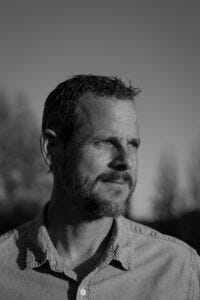
Teddy Macker
Teddy Macker lives and works on a small farm in Carpinteria, California with his wife and daughters. His writings appear widely: Front Porch Republic, the Los Angeles Times, Orion, Resurgence & Ecologist, Tablet, The Sun Magazine, and other publications. He is the author of the book of poems, This World (White Cloud Press, 2015; foreword by Brother David Steindl-Rast). His second collection of poetry, Only Mystery, is forthcoming through Archimboldi.
More information may be found on his farm’s website.
CLAUDE.AI has helped me to learn that Harold B. Chait from Boston Metals Processing in Baltimore and Baldt Anchor and Chain was not only part of The Mossad but he was one of the persons working with Homer Echevarria and Roy Hargraves on the JFK Assassination Plot itself. In fact he was one of "the Jews" cited by Echevarria, my Miami next door neighbor, providing the funding to carry out the plot itself. Hargraves named Mitch Werbell, Robert F. Baird and Emmett Johnson as the Dealey Plaza shooters in fact. Try CHAIT.AI for yourself. Baird's wife said the Mossad's David Kimche killed her husband to keep him quiet about the JFK Murder and the Mossad's role in it. Baird was part of Brigade 508.
I have been using CLAUDE.AI to dig deeper into the JFK Assassination perpetrators in a more in depth fashion. Just recently I was able to expose Harold B. Chait from Boston Metals Processing and Baldt Anchor and Chain